
Under the tiles
How does bathroom waterproofing work?
A continuous skin under the tiles keeps shower water inside the room. Nobody sees it once the tiles are down, which is why its details, its test and its paperwork matter more than anything else in the bathroom.
The membrane
How bathroom waterproofing works, layer by layer
Tiles and grout do not keep water out. Grout soaks it up, and the joints in a floor move a little over the years, so protecting the slab and the walls falls to a layer the eye never sees: the membrane. How bathroom waterproofing works comes down to three demands on that layer. It must cover every surface the water reaches, stay unbroken at corners, pipes and the drain, and prove itself before the tiles hide it.
How does bathroom waterproofing work?
A membrane, brushed on as a liquid or bonded down as a sheet, forms a continuous waterproof skin over the floor of the wet area and up the walls around the shower, on top of a screed that falls to the drain. Water that gets through the grout meets the membrane and runs along it to the drain instead of into the slab or the flat below. The weak points are the joints, so corners, pipe penetrations and the drain flange are reinforced, and the finished membrane is flood-tested before any tile goes down.
| Layer | What it is | The job it does |
|---|---|---|
| Slab | The building's concrete floor | Carries the rest; must be sound, clean and dry before work starts |
| Screed to falls | A sand and cement bed shaped to slope towards the drain | Moves water to the drain so none sits under the tiles |
| Primer | A coat that seals the screed's surface | Lets the membrane bond rather than peel |
| Membrane | Liquid coats or a bonded sheet | Stops water reaching the slab and the walls |
| Reinforcement | Tape or fabric at corners, joints and pipes | Holds the membrane together where it would otherwise crack |
| Tile adhesive, tiles and grout | The finished surface | Takes the wear; not waterproof on its own |
Some specifications add a second membrane under the screed as well. Either way, the one that matters most is the membrane the tile adhesive sits on, and it is the line we ask every contractor to price on its own in a bathroom renovation quote. The same stack, seen from the tiler's side, is on our tiling page.
Ask about waterproofing your bathroom
Which type of waterproofing is best for a bathroom?
The one applied as a complete system, to its maker's instructions, at the thickness its data sheet asks for. Each of the three families on the market works when that is true:
| Type | How it goes on | Its strength | Watch for |
|---|---|---|---|
| Flexible cementitious | Brushed or trowelled on in successive coats | Bonds well to screed and tolerates a damp base | Thickness is hard to check once it has dried |
| Liquid polymer, acrylic or polyurethane | Rolled or brushed in coats, sometimes in contrasting colours so gaps show | No seams; follows corners and pipes closely | Full cure between coats and before tiling |
| Bonded sheet | Sheets set in adhesive with overlapped seams | Even thickness, set at the factory | Every seam and corner is a joint to seal |
Mixing products is the failure to guard against. A primer from one maker, a membrane from another and an adhesive from a third may each be sound and still not bond to each other. Ask for the membrane's name and data sheet in the quote, and for the primer and adhesive that the same maker lists with it.
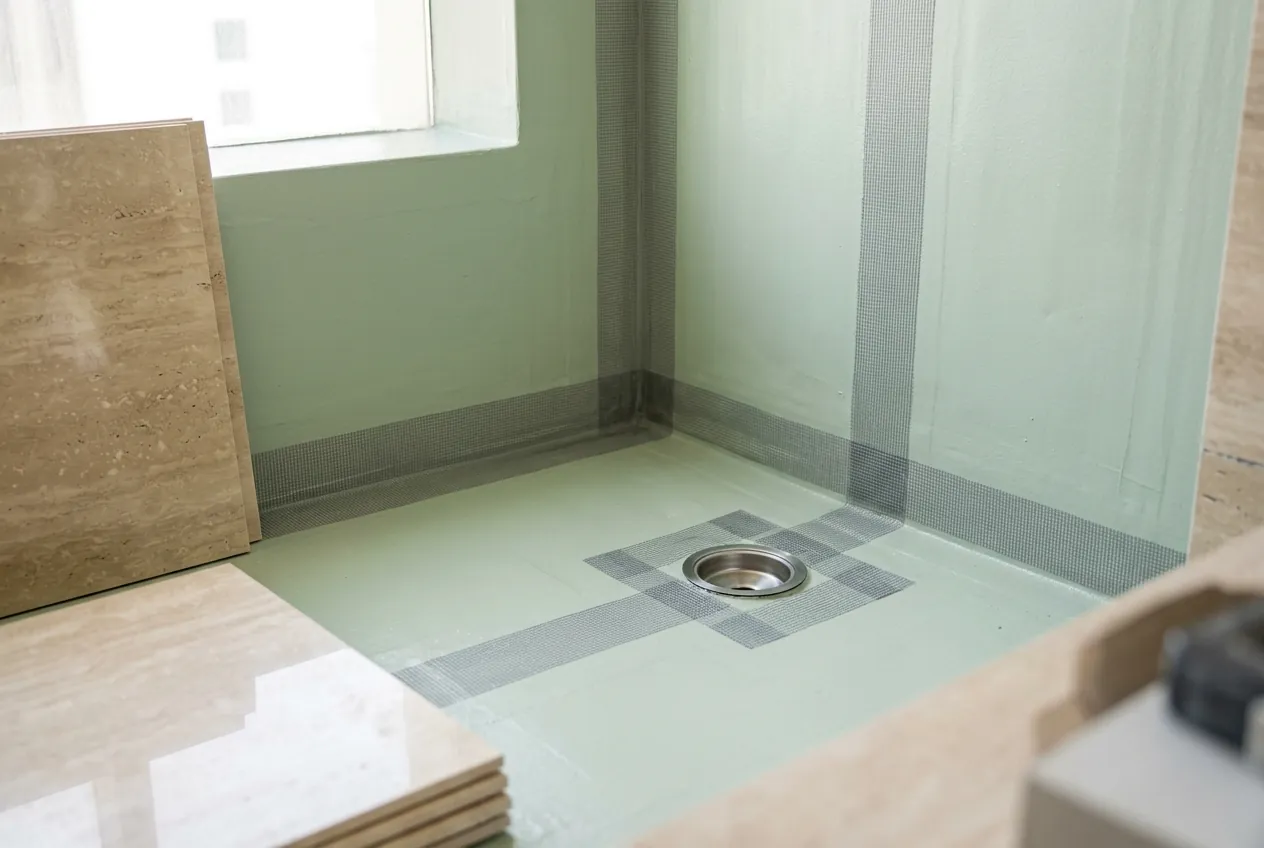
Where must the membrane go in a shower?
- Across the whole wet floor. With a tray, that is the floor around it; with a walk-in shower, it is every part of the floor the water can reach.
- Up the walls of the shower, at least as high as the spray lands, and in a steam enclosure over every wall and the ceiling.
- Into the corners between floor and wall, with a reinforcing tape bedded into the membrane, because movement cracks it there first.
- Around every pipe that comes through a wall or the floor, with a collar or a sleeve sealed into the membrane.
- At the doorway, turned up or stopped behind a threshold, so water on the floor cannot run out under the door.
Why is the drain joint the weakest point?
Because every drop of water on the floor ends up there. A floor drain made for tiled wet areas has a flange or a clamping ring that the membrane is bonded or clamped into, and a linear channel comes with its own collar for the same job. Where the old floor stays and the new one is built on top, the drain body has to be raised to meet the new surface, and the join between the old drain and its extension becomes the most likely leak in the room. An unsealed drain lets smells out as well as water in, as our guide to drain smells explains.
The flood test: how waterproofing works before the tiles hide it
A membrane can look perfect and still leak at one pinhole. The test finds it while the fix still costs almost nothing. The drain is plugged, the doorway dammed and the wet area filled with water, then left, and someone checks the room or the ceiling below before anyone tiles. In an apartment that means asking the neighbour below, or building management, for access.
Ask for three things in writing: that the test will happen, how long the water will stand, and who signs it off. A dated photo of the flooded floor costs nothing, and it is the only record you will ever have of the layer you paid for.
Do waterproofing works need a permit in Dubai?
Not from Dubai Municipality. Its circular 3-12-1 of 2022 puts insulation works on the list of simple maintenance, next to sanitary fittings and drainage, with no permit and no completion certificate, on one condition: the contractor has to be accredited with the Municipality. The community is a separate question, because renewing a membrane means lifting tiles.
- Town Square townhouses: replacing floor tiles in wet areas is a major alteration, AED 2,000 plus an AED 5,000 deposit.
- Emaar and Town Square apartments: existing floor tiles may not be removed at all, so the old membrane stays where it is, and any new one goes on top of the old tiles, under the new ones.
- Dubai Holding communities: a job that runs past a single day needs a Minor Modifications Permit, and repairs that damage a neighbouring property or a shared space carry a published AED 2,000 penalty.
How long should bathroom waterproofing last?
As long as the tiles above it, because replacing it means lifting them. No UAE authority publishes a period for a bathroom membrane, so the working answer is whatever the contract says: ask for the warranty in years, in writing, with the product named. The one authority document that asks a contractor for a waterproofing warranty is Ajman's completion certificate for new buildings, and it wants one for the roof. The renovation hub's warranty guide sets out what the rest of the clause should cover.
Roofs, terraces and basements need other systems, and our villa site covers villa waterproofing from the roof down. For the bathroom itself, full renovations that include the membrane start at AED 8,000 per bathroom, while a refresh from AED 3,000 leaves the membrane untouched; every band is listed on our price page.
Related
Questions
Waterproofing questions
- Can you waterproof over existing tiles?
- With the right product, yes. Some liquid membranes are made to bond to glazed tile after a matching primer, and in buildings that keep the old floor, such as Emaar and Town Square apartments, that is the only way to add a new one. A membrane painted onto tiles it was not designed for will lift, so ask for the data sheet.
- How do I know if my shower waterproofing has failed?
- Look for water where it should not be: marks on the ceiling of the room below, a skirting that stays damp outside the shower, grout lines that never dry out, tiles that ring hollow when tapped. Each one says the water has found a way under the surface.
- Does a walk-in shower need more waterproofing than a shower tray?
- It needs it over more floor. A tray catches the water and hands it to the drain, so the membrane mainly protects the walls and the floor around it. With no tray, every part of the floor the water can reach is the wet zone, and the membrane runs across all of it.
- How long must a membrane cure before tiling?
- As long as its data sheet says, which depends on the product, the thickness, and the room's temperature and humidity. The cure and the flood test are the two steps a rushed programme cuts, so ask for both in the quote with their durations.
- Is the bathroom floor outside the shower waterproofed too?
- Not always, and in a UAE bathroom it is worth asking for. The shattaf beside the WC and the basin put water on the floor every day, and a membrane that stops at the shower leaves the rest of the floor protected by grout alone.
Who you are dealing with
- OperatorWebsiteOS LLC
- Licence2646567.01
- Cost to homeownerNone
- Figures datedSeptember 2026
Tell us about the bathroom
How many bathrooms, their size, the community and what you want changed. We come back with contractors who quote against the published bands, and show you where each quote sits against them.