
Order of works
In what order should you do a bathroom renovation?
Approval first, then everything that will be hidden, in the order the water reaches it, then what you see. Each stage below says what it waits for, so a programme can be checked before work starts.
The sequence
Bathroom renovation order of works, from approval to handover
The order of a bathroom renovation follows the water. It is fixed at the drain's connection to the soil stack, carried by the slope of the screed and held by the membrane, so those are built first and tested before the tiles hide them. What you see and touch, the tiles, the fittings and the glass, comes last, each measured against the finished layer beneath it.
In what order should you do a bathroom renovation?
Approval, strip-out, drainage, screed, membrane and flood test, tiling, then sanitaryware, glass and sealant. The community's approval comes before anyone arrives: Emaar's turnaround is 3 business days from a complete file, Town Square's 2 or 5 working days, and Dubai Holding wants the request on its app at least 24 hours ahead. On site, each hidden layer waits for the one below it, and nothing is tiled until the flood test has passed. Sanitaryware follows the tiles and the glass is measured from them. Our timing guide turns the order into days.
Ten stages and what each one waits for
| Stage | What happens | Waits for | Checked by |
|---|---|---|---|
| 1. Approval | NOC or community permit; the contractor's entry or access pass | A complete file | The community |
| 2. Protect and strip out | Floors outside covered; fittings, tiles and screed out where allowed | Approval in hand, water isolated | Contractor |
| 3. Drainage and supply | WC, floor trap and shower waste set to the soil stack; hot and cold runs | An open floor and open walls | Plumber, with a pressure test on the supply |
| 4. First fix electrics | Power for lighting, the extractor and any heated rail or mirror | Open walls | Electrician |
| 5. Screed to falls | A bed of sand and cement, sloped to the drain | Drains fixed and the drain body set | A level run along the falls |
| 6. Membrane | Primer, reinforcing tape at corners and pipes, then the coats | A set, dry screed | The product's data sheet |
| 7. Flood test | Drain plugged, doorway dammed, water left standing | A cured membrane | Someone checking below or behind |
| 8. Tiling | Floor and walls, then grout | A passed flood test | Tiler, with the falls checked again |
| 9. Fittings and glass | WC, basin, vanity, mixers and accessories; glass measured and fitted | Tiles and grout set | Plumber and glazier |
| 10. Sealant and handover | Silicone at movement joints, cleaning, the snag list | Everything else | You, and the community where it inspects |
Three stages carry the weight: the drain positions in stage 3, the falls in stage 5 and the test in stage 7. A mistake in any of them is invisible by stage 8 and costly to reach after it.
Send us the bathroom and the dates
Why does the drain come before everything else?
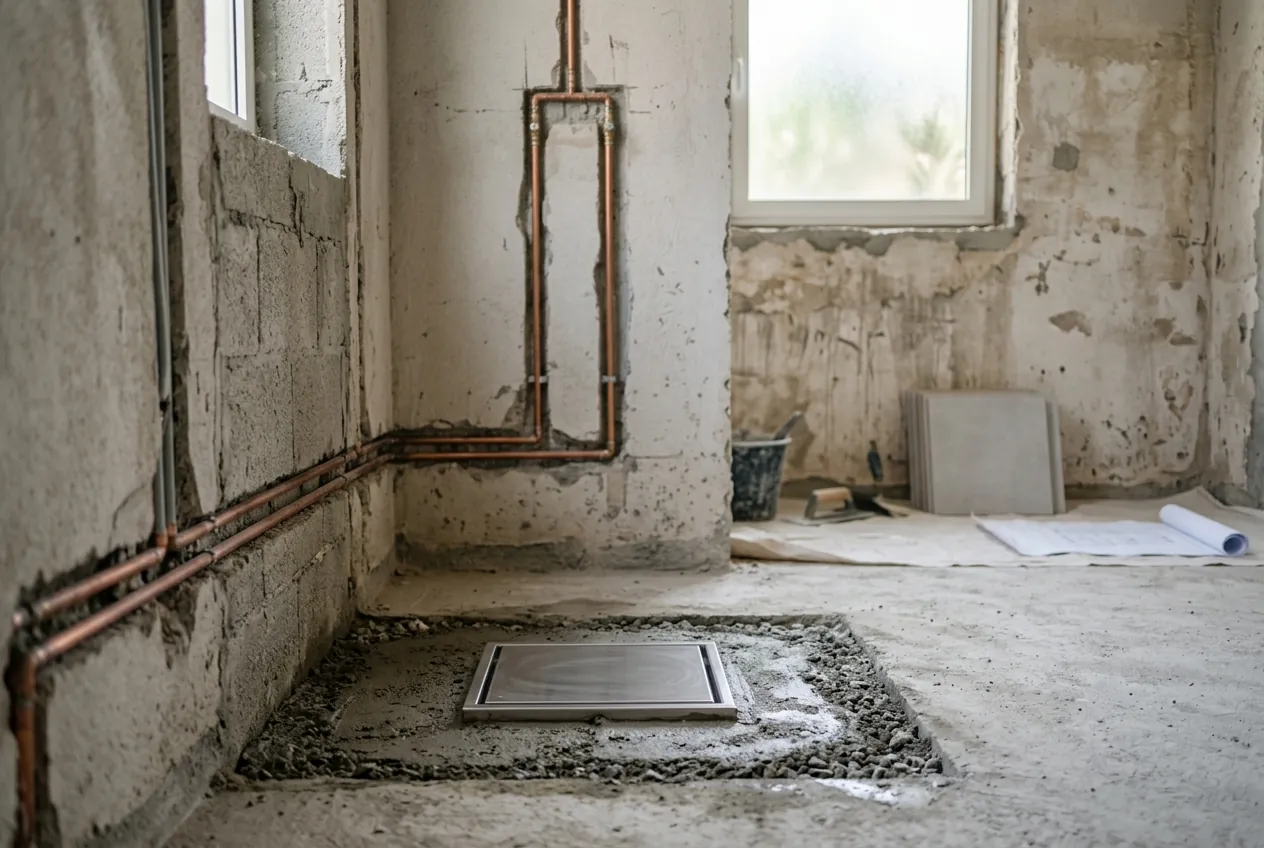
Because the WC is the fitting with the least freedom. It empties by gravity into the soil stack, so its position fixes the floor levels, the slope of the screed and the tile layout that follow. A floor trap or a shower waste set after the screed would sit at the wrong height for the membrane to seal to.
Where the WC stays put, stage 3 shrinks to new connections in the old positions, which is also the only version Emaar allows in its apartments, where the factsheet does not let MEP services move. Our permit guide sets out who has to agree when anything does move.
Which stages can overlap in a bathroom renovation?
Choosing can overlap with building; building rarely can. Tiles, sanitaryware and the style of glass can be chosen and ordered while the approval is pending, so they are on site when their stage comes. On site, the plumber and the electrician can share the first fix, but screed, membrane, test and tiles follow one another in a room where one trade works at a time.
One thing not to bring forward is the glass order. A screen made to measure is measured from the finished tiles, so its lead time runs from the end of stage 8, not from the start of the job.
What order works for two bathrooms in a villa?
One after the other, staggered so that one room's waiting stages, the screed setting and the membrane curing, fall on days the crew spends in the other. That keeps a working WC in the house and keeps the trades busy. Price each bathroom as its own line, because each one is a separate job in every published band. In a Dubai Holding community a programme this long also outlasts the 7-day Minor Modifications Permit, so the extension goes in writing before it runs out.
Does the order change in an apartment?
The order stays; two stages change size. Where the existing floor tiles have to stay, as in Emaar and Town Square apartments, the strip-out leaves the floor in place, and any new membrane goes over the old tiles with a primer made for them, the drain grating raised to meet the new floor. Where MEP may not move, the drainage stage becomes reconnection in place. Two steps join the front of the list: the building management's own consent, and a service-lift booking for the day the old fittings leave.
A programme you can check
Ask each contractor for the programme as a list of these stages with working days against each, and check three things: that the flood test has a day of its own, that tiling starts after it, and that the glass is measured after the tiles. A programme that folds stages 5 to 8 into one line has left no room for any of them to wait. Our common mistakes page lists what goes wrong when the order slips, our price table gives the per-bathroom bands, and our bathroom service collects the stages from every contractor in writing.
Related questions
Sequence questions
- Is the vanity fitted before the tiles or after?
- After, in most bathrooms. The floor and wall tiles run behind and under it, so the unit can be changed later without a gap in the tiling, and the plumber leaves its supply and waste points at the right height during the first fix.
- When should the extractor fan be fitted?
- Its power and duct route go in with the first fix, before the walls are closed; the fan itself is fitted with the other finishes. Without a working extractor, new grout and sealant stay damp longer.
- When is the ceiling done?
- After the first fix, so the lights and the extractor can be wired through it. In Town Square a false ceiling is itself a major alteration, so it needs its approval before the job starts.
- Can I use the shower as soon as the glass is in?
- Not until the silicone has cured, for as long as its maker states. Using the shower earlier washes the sealant out of the joints it is meant to close.
- Who sets the order on site?
- The contractor you sign with. We put the order of works into the brief and ask each contractor to price and programme the same stages, so their answers can be compared. There is no charge to you.
Who you are dealing with
- OperatorWebsiteOS LLC
- Licence2646567.01
- Cost to homeownerNone
- Figures datedSeptember 2026
Tell us the bathroom and the start date
How many bathrooms, the community and when you would like to start. We come back with contractors who put the stages and their days in writing, against the published bands.