
Wet-area tiles
Which tiles work best in UAE wet areas?
Humidity rarely hurts a good tile. It finds the grout, the silicone and the adhesive first, so choosing tiles for a UAE bathroom is half about the tile and half about what holds it in place.
Tile choice
Tiles for wet areas: what the UAE climate tests
Choosing tiles for wet areas in a UAE home means planning for two kinds of water. One kind lands on the floor, from a shower or from the shattaf beside the WC. The other hangs in the air: a bathroom that fills with steam every morning and then cools under the air conditioning. A dense, well-fixed tile copes with both. The joints between the tiles are where the trouble starts.
What are the best tiles for UAE wet areas?
Porcelain for any floor that gets wet, because it is fired so dense that water barely enters the body, and its textured and matt versions stay safe underfoot. Glazed ceramic belongs on walls. Mosaic suits shower floors that fall to a drain, since its many grout lines add grip, and stone like marble or travertine works only when it is sealed and kept away from acidic cleaners. Whatever the tile, the grout, the silicone and the adhesive decide how the surface ages in humidity.
| Tile | Water it takes up | Grip when wet | Best place | Watch for |
|---|---|---|---|---|
| Porcelain | Very little | Good in matt or textured finishes | Shower and bathroom floors, walls | Polished finishes turn slippery |
| Glazed ceramic | Little at the glaze, more in the body | Poor to fair | Walls and splashbacks | A chip exposes the thirstier body |
| Glass or porcelain mosaic | Very little | Good, from the grout lines | Shower floors laid to falls, niches | Many joints to keep clean |
| Marble, travertine and other stone | Varies; porous until sealed | Honed is safer than polished | Walls, vanity tops, dry floors | Acidic cleaners etch it; reseal it |
| Terrazzo and cement tiles | Porous until sealed | Fair when honed | Floors outside the shower | Stains without a sealer |
Read the grip column first for any floor, and ask for the slip-resistance rating on the tile's data sheet rather than judging it in a dry showroom. Our tiling service page covers the laying, and the bathroom service treats tiles as an allowance you control, inside bands that start at AED 8,000 per bathroom for a full renovation; a refresh from AED 3,000 keeps the tiles you have.
Does UAE humidity damage bathroom tiles?
Rarely the tile itself. Porcelain and glazed ceramic do not mind damp air. What humidity attacks is everything around them. Cement grout takes up water and, in a room that never fully dries, grows mould along its lines. Silicone at the edges lets go when it was laid on a surface that was not clean and dry. Adhesive laid in dabs instead of a full bed leaves pockets under the tile where water collects, and that shows up later as hollow tiles and dark grout.
The air conditioning adds a twist. A bathroom cooled to a comfortable temperature and then filled with hot steam puts condensation on every cold surface, the tiles included, so a room with good extraction keeps its grout cleaner than one without, whatever tiles are on the wall.
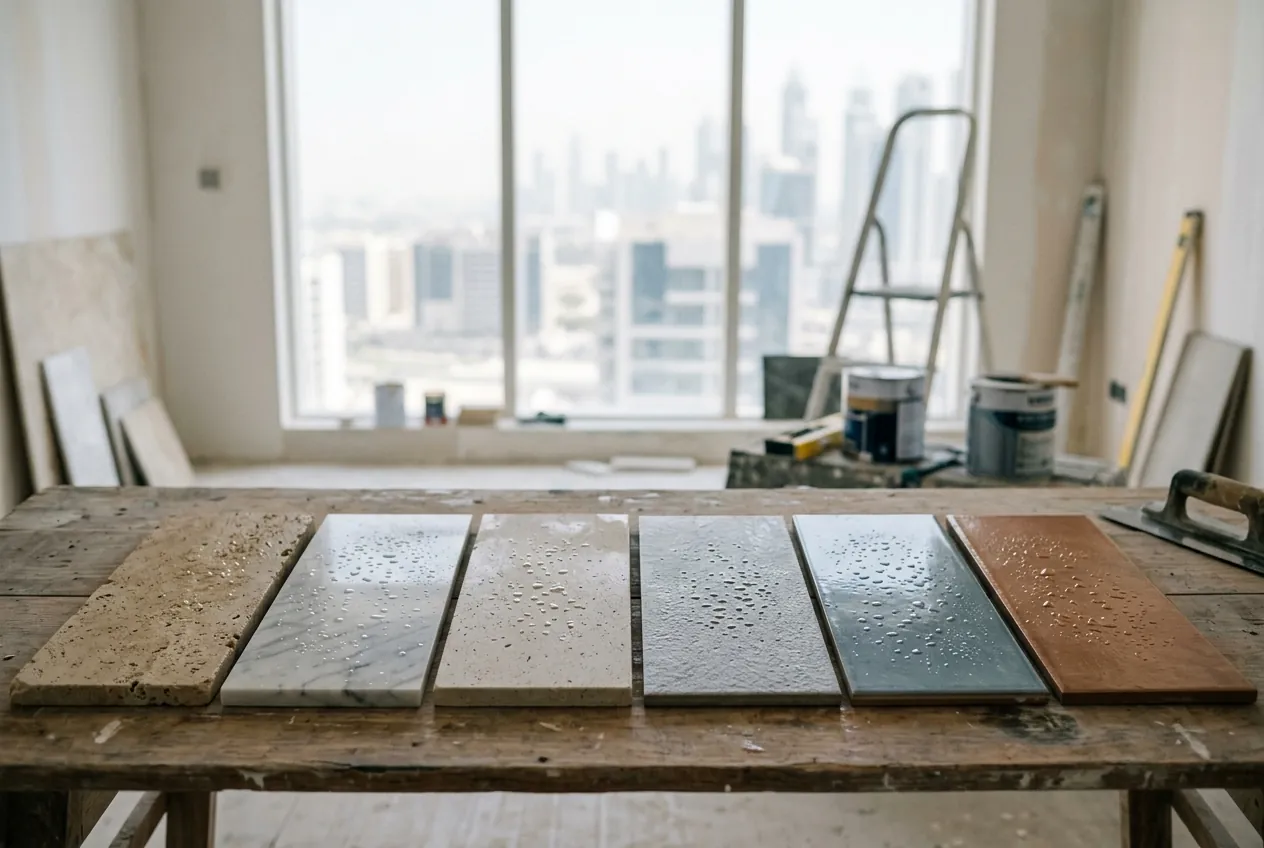
Which tiles are moisture resistant enough for a shower floor?
Porcelain and mosaic, chosen for grip as much as for water. A shower floor is wet, soapy and sloped towards the drain, so a matt or textured surface matters more here than anywhere else in the home. Tile size has to suit the drain as well. A point drain pulls the floor down from several sides, so small tiles or mosaic follow the slope without lipping; a long channel lets the floor fall one way and takes larger tiles. Our walk-in shower page compares the two drains.
What holds tiles in place in wet areas?
- Grout. Cement grout is standard and needs sealing in a shower. Epoxy grout takes up almost no water and resists stains, which is why it earns its higher price on shower floors, around a shattaf and inside a steam enclosure.
- Adhesive. A full bed under every tile in a wet area, with no voids, and a flexible adhesive where the floor or wall is likely to move. Large tiles need adhesive on both the tile and the floor.
- Silicone, not grout, at movement joints. Wherever the floor turns up a wall, around a shower tray or the WC pan, and at every change of material, a sanitary silicone takes the movement that would crack grout.
- Sealer for stone. Marble, travertine and cement tiles are sealed when laid and again as the sealer wears, and cleaned with products that suit the stone.
Which tiles suit a steam room or a walk-in shower?
A steam enclosure runs hot and wet on every surface, the ceiling included, so it wants porcelain or glass mosaic, epoxy grout and an adhesive rated for heat and constant wetting. A walk-in shower wants the same floor tile as the rest of the bathroom where the floor runs through without a step, with a textured finish and, often, mosaic inside the shower zone for extra grip. A powder room floor still takes water from the shattaf, so the same rules apply at a smaller scale, as our powder room page shows.
Tiling over old tiles in wet areas
In Emaar and Town Square apartments the old floor has to stay. Emaar's apartment rules allow new tiles only on top of existing ones, and Town Square's apartment manual forbids lifting floor tiles and allows new ones on top everywhere except balconies. In a wet area that changes the choice of tile: the new tile has to bond to a glazed surface, so the tiler primes it for the adhesive, and a thin tile keeps the extra height at the door and the drain small. The membrane under the old tiles stays where it is, and whether a new one goes on top is the question our waterproofing guide answers.
Questions
Tile questions
- Is epoxy grout worth it in a UAE bathroom?
- In the wettest places, usually yes: a shower floor, a steam enclosure, the floor around a shattaf. It takes up almost no water and resists staining, so it stays cleaner in a humid room. It costs more and is slower and less forgiving to lay, which is why it is often kept to the wet zones.
- Why does the grout in my bathroom keep turning black?
- Mould, most of the time, feeding on water and soap in a cement grout that never dries out. Better extraction and a grout sealer slow it down. Grout that stays dark even when the room is dry is a different signal: water may be sitting under the tiles, which points at the membrane or the drain joint.
- Can I use wood-look tiles in a bathroom?
- Yes, in porcelain. Choose a matt or textured finish for the floor, keep long planks out of a shower floor that has to fall to a point drain, and let a channel drain or a different tile take the shower zone.
- Do anti-slip tiles matter in a bathroom?
- On any floor that gets wet, yes: the shower, the area around the shattaf, and a walk-in shower floor that runs into the room. Ask for the slip-resistance rating on the data sheet. A polished tile that looks the part in a dry showroom behaves very differently with soap and water on it.
- Should wall tiles and floor tiles be the same?
- They can be, but they do not have to be. Walls take splashes and steam, not feet, so glazed ceramic works there, while the floor needs the density and grip of porcelain. Using one porcelain tile for both keeps the look continuous.
Who you are dealing with
- OperatorWebsiteOS LLC
- Licence2646567.01
- Cost to homeownerNone
- Figures datedSeptember 2026
Tell us about the tiles
How many bathrooms, their size, the community and what you want changed. We come back with contractors who quote against the published bands, and show you where each quote sits against them.